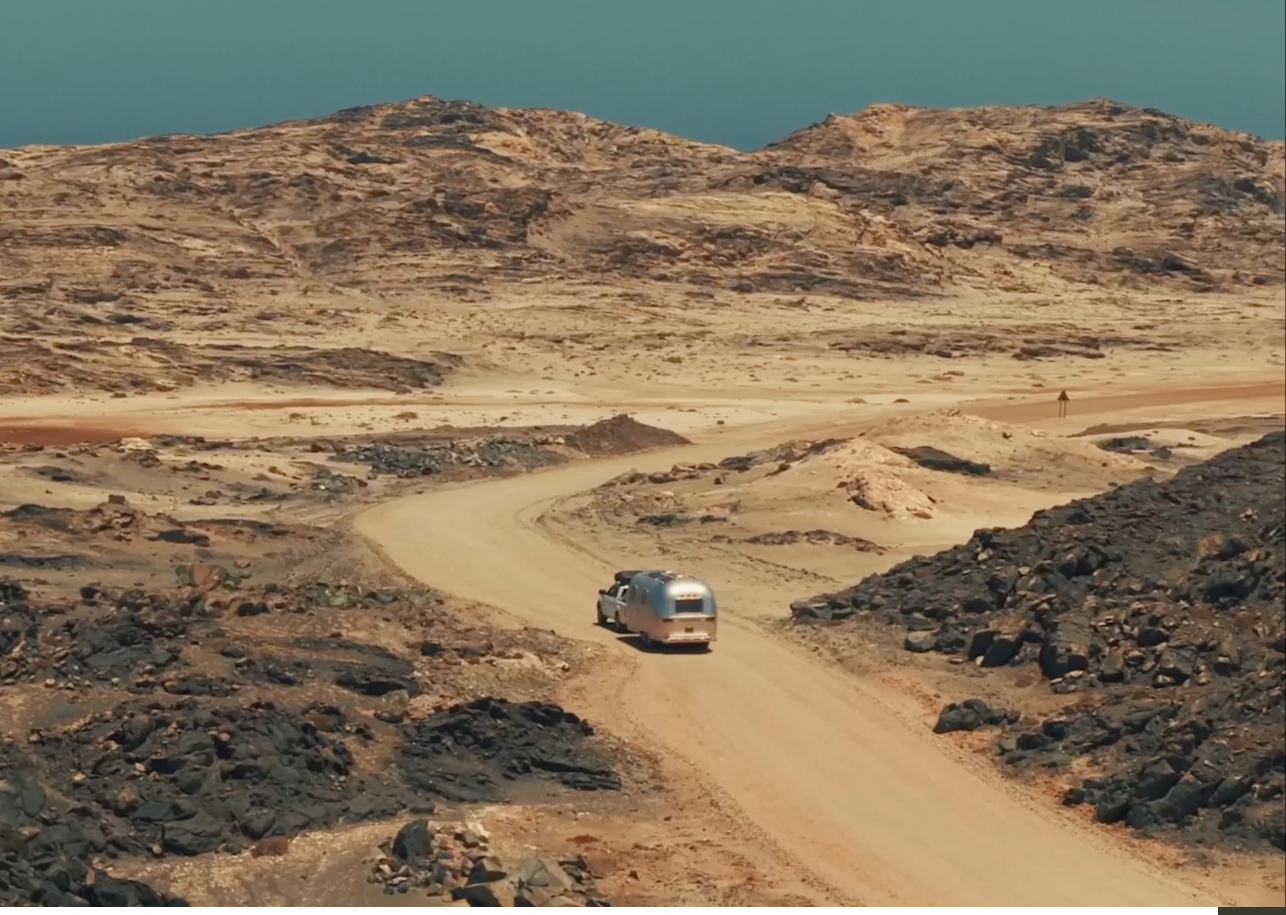
Recording the World, One Journey at a Time: Thylacine’s Mobile Studio Meets Namibia
From a solar-powered Airstream to the Namib Desert: how French artist Thylacine captured music beyond borders – with the help of Neumann and Sennheiser.
Berlin, April, 2026 - What happens when cutting-edge audio technology meets one of the world’s most traditional musical cultures? For French producer and composer Thylacine, the answer lies somewhere between the open road, a 1972 Airstream caravan, and a once-in-a-lifetime recording journey in Namibia. Supported by Neumann and Sennheiser, his latest project, Roads Vol. 3, proves that great sound knows no boundaries.
For Thylacine, making music has never been about staying in one place.
“I love to make music when I travel,” he explains. “To get inspired by different cultures – or even by sounds themselves.” That desire for freedom led to an idea that would become central to his creative process: transforming a vintage 1972 Airstream caravan into a fully autonomous recording studio. Powered by solar panels, equipped with large battery systems, and acoustically treated inside, the mobile studio allows professional recording anywhere in the world.
With this studio on wheels, Thylacine has already journeyed through Argentina, the Faroe Islands, and now Namibia – the destination for his album Roads Vol. 3.


.png)
Music Beyond Western Influence
Namibia offered something Thylacine had been searching for: musical traditions shaped entirely outside Western culture. “I was really curious about making music with people that are not influenced by Western culture,” he says. “And to see how music can be experienced in other parts of the world.”
That curiosity led him to collaborate with members of the Himba, a semi-nomadic community who live without electricity or modern technology. After spending a week living nearby and being introduced through a local woman who helped bridge the language gap, trust began to grow.

“Once we became friends, I explained my project and asked if they wanted to take part in the album,” Thylacine recalls. “They were really excited.” The collaboration was handled with care and respect: participants were paid, credited on the album, and invited into a professional recording process – albeit one unfolding under the open sky. “We spent two hours making music together, dancing,” he says. “It felt like a challenge – proving what we could create together.”

.png)
.png)
.png)
Capturing Space, Sound, and Presence
Recording music in the desert meant rethinking traditional studio workflows. This is where Neumann technology played a crucial role. One standout tool was the Neumann KU 100, affectionately nicknamed “Bob” by the team. Designed to replicate human hearing, the binaural microphone allowed Thylacine to capture an immersive, three-dimensional sound image.
“I could put it in the middle of the group and people would sing or clap all around,” he explains. “You get this amazing spatial sound.”
The KU 100 quickly became a point of curiosity – and humor. “They would laugh at Bob,” Thylacine says. “Some people would talk to it. We even put a hat on it to make it more friendly.” Alongside the KU 100, Thylacine relied on a carefully selected setup for different recording needs:
- A Neumann U 47 Fet for lead voices and solo instruments
- Neuman MT 48 Audio Interface and NDH 20 headphones
- Neumann KH 310 Speakers
- Sennheiser MKH 8090 and MKH 8060 for ambient sounds and details
- Sennheiser HD 25 headphones
“For solo voice or instruments, the U 47 FET is my go-to microphone,” he notes. “It’s an instrument on its own.”
.png)
.png)
Listening Differently
Playback was just as revealing as recording. When members of the Himba community tried headphones, their reaction was brief but telling. “They might listen for 20 or 30 seconds," Thylacine remembers, “and then say, ‘Oh, it’s cool, but real music is face-to-face, you know, singing together'.” That moment became a personal revelation. “We’ve become very passive with music sometimes,” he reflects. “They experience music very actively. That really changed my perspective.”
Throughout the journey, Thylacine relied on Sennheiser HD 25 headphones for recording and his personal Neumann NDH 20 for critical listening – tested across dust, heat, and countless miles on the road. It’s been on a lot of trips,” he says. “But it’s my favorite.”
.png)
.png)
.png)
From composing alone in the desert to sharing demos back with the community before leaving, the Namibia project left a lasting impression. “It was a mind-blowing experience,” Thylacine says simply.
Roads Vol. 3 is not just an album – it’s a document of encounters, trust, and shared creativity. And it’s proof that when artists are given the freedom to explore, and the right tools to capture the moment, music can truly become a universal language.
More information: https://www.thylacinemusic.com/
Stay up to date and follow Neumann on: FACEBOOK | INSTAGRAM | YOUTUBE
About Neumann
Georg Neumann GmbH, known as “Neumann.Berlin”, is one of the world’s leading manufacturers of studio-grade audio equipment and the creator of recording microphone legends such as the U 47, M 49, U 67, and U 87. Founded in 1928, the company has been recognized with numerous international awards for its technological innovations. Since 2010, Neumann.Berlin has expanded its expertise in electro-acoustic transducer design to also include the studio monitor market, building upon the legacy of the legendary loudspeaker innovator Klein + Hummel. The first Neumann studio headphones were introduced in 2019, and since 2022, the company has increased its focus on reference solutions for live audio. With the introduction of the first audio interface MT 48, and its revolutionary converter technology, Neumann now offers all the necessary technologies needed to capture and deliver sound at the highest level. Georg Neumann GmbH has been part of the Sennheiser Group since 1991 and is represented worldwide by the Sennheiser network of subsidiaries and long-standing trading partners. www.neumann.com


