From Analog Roots to Hybrid Orchestras: Emmanuelle Husson on Sound, Technology and Musicianship
Enabling new workflows with Venue Mission for Anubis
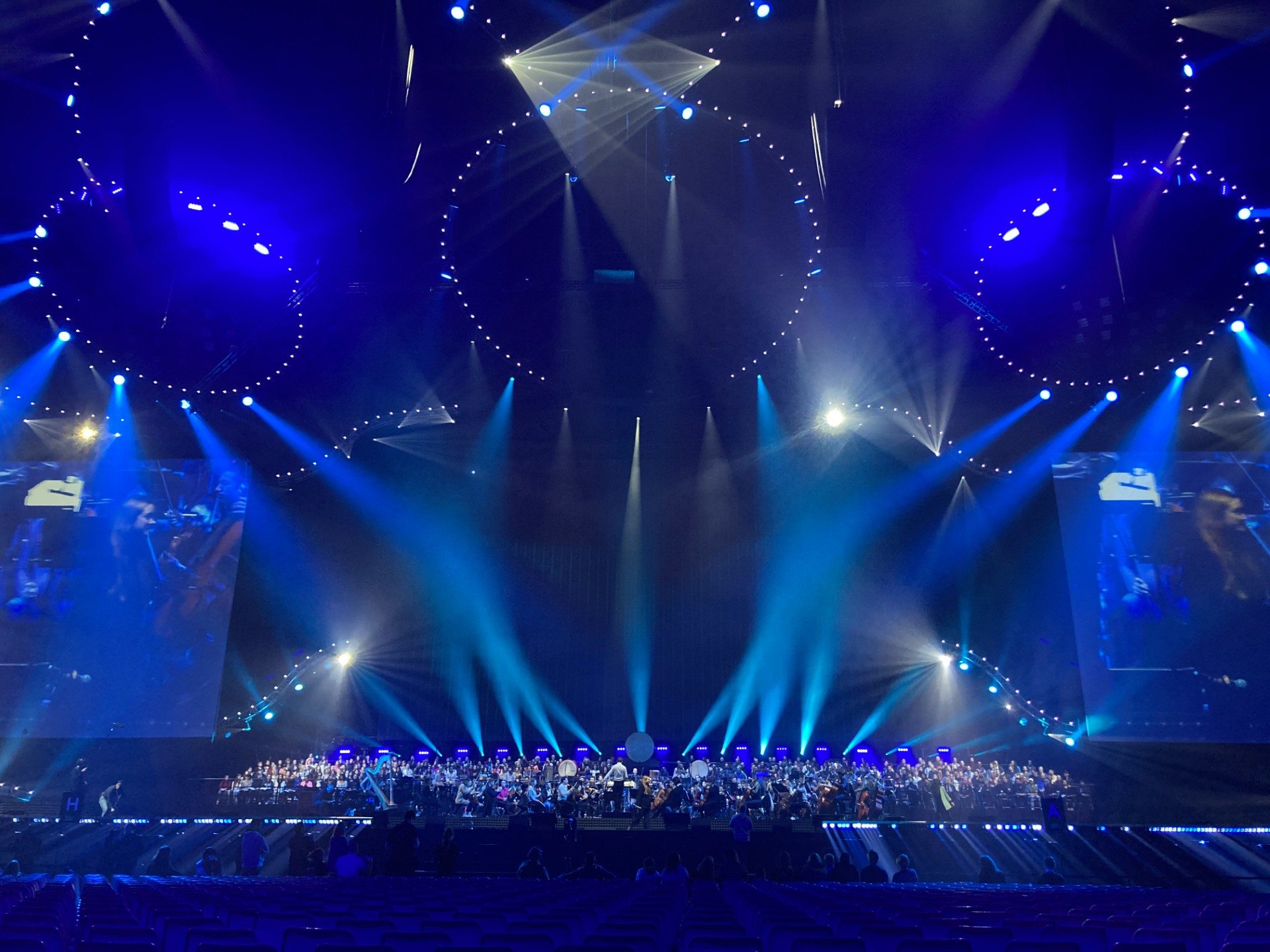
Paris, August xxth, 2026 – With 30 years in live sound, Emmanuelle Husson has navigated every major technological shift in the industry - from analog consoles to IP audio networking - without ever losing sight of what matters most: the performer. Founder of Radioactivités SARL, based in Vernon, Normandy, her work covers four core areas: RF coordination for large-scale events, professional training, proprietary solutions - including Solution Anacrouse for orchestral monitoring and recording - and live capture. Key references include the Johnny Symphonique Tour, Louis Vuitton Fashion Week Paris, the Fête des Vignerons Vevey 2019 and Watches & Wonders Geneva.
Emmanuelle Husson’s path into audio was anything but accidental - it was immediate and instinctive. From the age of twelve, she was studying music theory and composition at the conservatoire. The defining moment came when a teacher introduced her to contemporary music and took her to a Pierre Henry concert. That experience changed everything.
“I walked out of that concert knowing I wanted to work with sound - with musique concrète. I understood that sound would be my medium.”
By fourteen she was already working in a studio environment. By sixteen she had entered the professional world. Her dual background - musical and technical - laid the foundation for a career bridging artistry and engineering.
Live Sound vs. the Studio
Despite her studio background, Emmanuelle gravitated naturally towards live sound. The reason was straightforward: immediacy.
“In the studio, everything gets reconstructed - the automation, the editing, the fixes. In live sound, everything happens in the moment. That’s what I wanted.”
She moved into front-of-house mixing and system deployment, but quickly ran into the barriers many women face in a male-dominated industry. Early on, she was told that certain roles - system rigging and PA alignment among them - were not for her. Rather than stepping back, she pivoted.
She moved into RF - radio frequency coordination - initially by opportunity, but rapidly developed deep expertise in the field.


Becoming an RF Specialist
RF engineering became one of her defining specializations. What began as a workaround evolved into a core competency, particularly in complex environments involving large-scale wireless deployments.
Her analytical mindset - grounded in strong mathematical foundations - enabled her to master signal transport, frequency coordination, and extended RF coverage planning. Over time, she became a recognized specialist in complex RF scenarios: large venues, hybrid productions and major event opening ceremonies.
But the technical work was never an end in itself. Every decision came back to the same question: what does this mean for the performer?
The Turning Point: Understanding Musicians
A significant shift in Emmanuelle’s career came when she began working closely with classical musicians in amplified and hybrid contexts.
Traditional orchestras are built for acoustic environments. Place them on large stages or outdoors, and they face challenges they were never designed to handle: latency, monitoring, spatial coherence, and the absence of dedicated room acoustics.
The most critical issue she identified was latency in IEM (in-ear monitoring) systems. Even small delays - in the range of 6 to 8 milliseconds - can disrupt a musician’s ability to “build” a note, particularly on instruments like violin or voice, where self-monitoring is fundamental.
“A violinist hears their instrument a few centimeters from their ear. Introduce a delay equivalent to two meters of sound propagation - everything changes. They won’t tell you ‘there’s latency’. They’ll tell you ‘I can’t find my sound.’”
That insight reshaped her entire approach.
The Anacrouse Approach: Technology in Service of the Musician
At the core of Emmanuelle’s response to these challenges is Solution Anacrouse - a comprehensive approach to orchestral monitoring that spans the entire signal chain, from mic capture through to distribution to the FOH and monitor consoles, placing the musician’s perception above all else.
At the heart of the system lies the Merging Technologies Anubis running Venue Mission. The Anubis is a networked audio interface - compatible with Dante, ST2110/AES67 and Ravenna - delivering end-to-end signal processing at 0.38 ms latency. Venue Mission is an application developed at Emmanuelle Husson’s initiative, in close collaboration with Merging Technologies, directly from field-identified requirements. It is not simply one component of the system - it is its backbone.
Anubis Venue Mission Screenshots


Running on the Anubis Venue Mission platform, end-to-end latency figures are low enough to preserve the physical relationship between instrument and ear - the relationship that allows musicians to shape their tone and build their note with confidence.
More importantly, the system enables each musician to:
- Receive their instrument feed in real time, with uncompromised signal fidelity
- Build their own personal monitor mix in real time
- Wear both IEM drivers comfortably throughout the performance
Rather than imposing a predefined workflow, the Solution Anacrouse approach enables each musician to personalize their monitoring environment to their own requirements.

Rethinking Monitoring: From Engineer Control to Performer Autonomy
Emmanuelle’s philosophy is straightforward but radical:
- The musician must hear their instrument exactly as they know it
- They must control what they hear
- There are no fixed rules - only individual requirements
- The signal must be captured and transported with maximum fidelity for distribution to the FOH and monitor consoles
Within the networked audio ecosystem, via the Anubis Venue Mission, each musician can:
- Position their own spot microphones
- Build personalized mixes from stems prepared by the monitor engineer
- Select which elements to include or exclude from their monitor mix
The system also gives FOH and monitor engineers direct access to all sources at the closest possible point to the orchestra microphones - a significant advantage for overall mix management.
“Some musicians want to hear everything. Others want almost nothing. What matters is giving them the choice.”
This approach stands in sharp contrast to traditional workflows, where engineers define the mix and musicians are expected to adapt to it.
Hybrid Orchestras: Bridging Two Worlds
Modern productions increasingly combine classical orchestras with amplified music - pop, rock or electronic. These hybrid formats bring together two very different professional cultures.
On one side: classical musicians trained in acoustics, nuance and natural balance.
On the other: sound engineers working with amplification, signal processing and gain structure.
Miscommunication is common. Classical musicians can feel misunderstood; engineers can find orchestras difficult to manage technically. Emmanuelle’s work sits precisely at that intersection. The goal is not only technical success, but mutual understanding.
“When it works, everyone is happy - the musicians, the engineers, the audience. But getting there means being willing to rethink everything.”

Technology as a Tool, Not an End
Throughout her career, Emmanuelle has contributed to product development by working closely with manufacturers to design tools that address real-world needs. In this spirit, Radioactivités SARL helped initiate the Venue Mission on Anubis in collaboration with Merging Technologies.
Her guiding principle is clear: Technology must serve the user - not the other way around.
“A product shouldn’t exist because it’s technically possible to build. It should exist because it solves a real problem.”
Solution Anacrouse stands out not for its specifications alone, but for the way it enables entirely new workflows - ones that were previously impossible in orchestral environments.
Conclusion
Emmanuelle Husson’s career is not simply a story of technical evolution - it is a reminder that sound engineering is, at its core, a human discipline.
“I want musicians to leave the stage happy. I want the audience to be happy.”
From analog consoles to digital networks, from rock tours to symphonic productions, the work of Radioactivités SARL consistently returns to one idea: understanding how humans create and perceive sound. With the development of Solution Anacrouse - anchored in tools such as the Merging Technologies Anubis Venue Mission - Emmanuelle Husson demonstrates how technology, properly applied, can disappear entirely behind the experience it enables.
Because in the end, the success of any system is not measured in specifications - but in whether the musician can truly hear themselves on stage.
For more information, please visit: www.radioactivitees.com
Stay up to date and follow Neumann on: FACEBOOK | INSTAGRAM | YOUTUBE
Downloads
Technical_Sheet_Merging_Anubis_and_Missions_V1.pdf
PDF 996 KB
Merging_Product_Portfolio_2025_landscape_V1.pdf
PDF 2.2 MB
Merging_Product_Portfolio_2025_mobile_V1.pdf
PDF 1.9 MB
About Neumann
Georg Neumann GmbH, known as “Neumann.Berlin”, is one of the world’s leading manufacturers of studio-grade audio equipment and the creator of recording microphone legends such as the U 47, M 49, U 67, and U 87. Founded in 1928, the company has been recognized with numerous international awards for its technological innovations. Since 2010, Neumann.Berlin has expanded its expertise in electro-acoustic transducer design to also include the studio monitor market, building upon the legacy of the legendary loudspeaker innovator Klein + Hummel. The first Neumann studio headphones were introduced in 2019, and since 2022, the company has increased its focus on reference solutions for live audio. With the introduction of the first audio interface MT 48, and its revolutionary converter technology, Neumann now offers all the necessary technologies needed to capture and deliver sound at the highest level. Georg Neumann GmbH has been part of the Sennheiser Group since 1991 and is represented worldwide by the Sennheiser network of subsidiaries and long-standing trading partners. www.neumann.com


